The 2026 FIFA World Cup kicks off June 11, and for the first time ever, it's happening right here in North America, across 16 cities in the US, Canada, and Mexico. Forty-eight teams. Thirty-nine days. And a whole lot of kids watching some of the best soccer on earth.
Watching is one thing. Building is another. These five projects give kids ages 8 and up a reason to get off the couch, dig into some engineering, and make the World Cup season something they can actually hold in their hands.
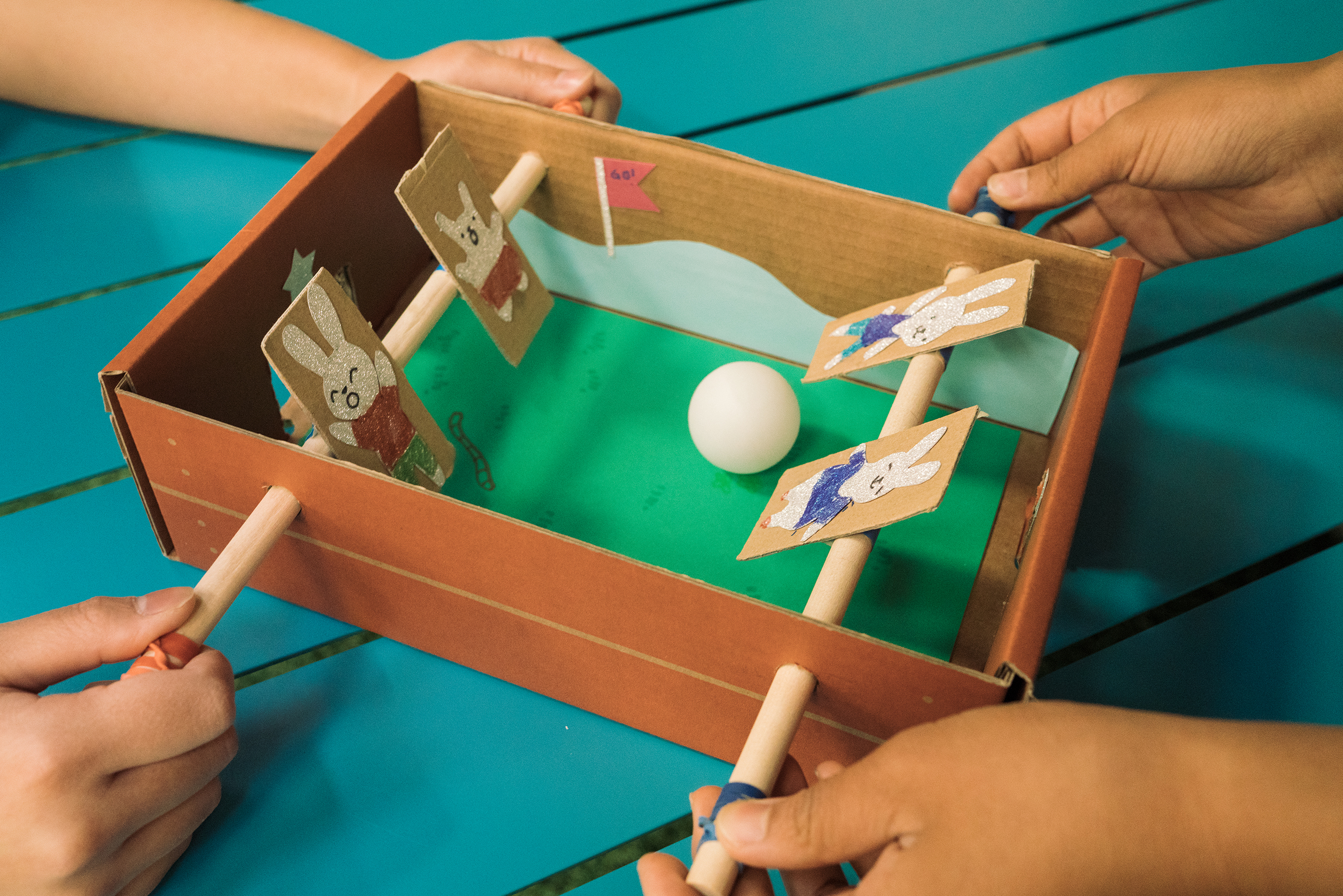
Build a Mini Foosball Table
All you need is a cardboard box, a few wooden dowels, and some creativity. Kids cut out the goals, thread the dowels through, attach their players, and suddenly they've got a working tabletop game. The real engineering challenge is in the mechanics: getting the dowels to spin smoothly, spacing the players so the ball actually moves, and making the structure sturdy enough to survive a real match.
This one is full of structural engineering. Kids figure out load, balance, and how mechanical linkages translate hand movement into player movement on the field. Try this project here.
Engineer a Backyard Goal
PVC pipe, zip ties, and a length of netting. Kids design the dimensions, calculate how much material they need, and figure out how to make it freestanding. Then they test it. If it buckles when someone kicks a ball into the net, they go back and fix it. This Old House has a tutorial that even uses the finished goal to teach the Pythagorean theorem in real life.
Structural engineering and iterative design. The testing-and-fixing loop is exactly how real engineers work. Full instructions here.
Design Your Own Soccer Ball
A regulation soccer ball is a truncated icosahedron: 20 hexagons and 12 pentagons fitted together into a near-perfect sphere. Kids can recreate this with paper, scissors, tape, and a little patience. Print or draw 20 hexagons and 12 pentagons, all with equal side lengths. Cut them out, then tape them together following the pattern: each pentagon is surrounded entirely by hexagons, and no two pentagons touch. As the panels connect, the shape naturally curves into a sphere. Decorate each panel in the colors of a favorite World Cup team before assembly.
Pure geometry and spatial reasoning. The same mathematical relationship between pentagons and hexagons that makes a soccer ball round shows up in carbon molecules, architectural domes, and viral protein shells. Building one by hand makes that connection impossible to forget.
Build a Rube Goldberg Goal Scorer
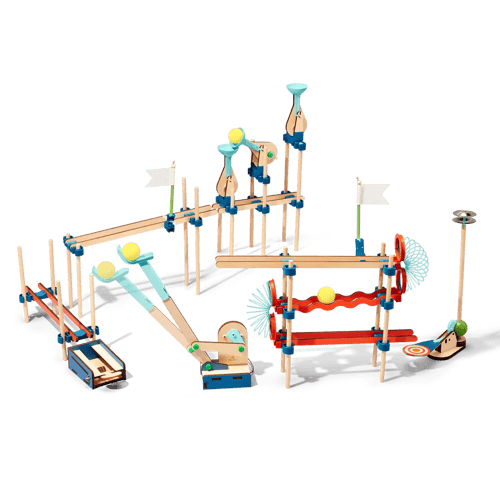
The goal: get a ball to roll into a small goal without touching it directly. Start by setting up the goal at one end of a table. Work backward from there, designing a chain of at least five steps. A book propped as a ramp. A marble that rolls and knocks over a row of dominoes. A domino that tips a cardboard lever. The lever drops a toy car down another ramp. The car nudges the ball across the goal line. Each element has to trigger the next without help. When something fails, which it will, kids diagnose exactly where the chain broke and fix that step. Getting a full run to complete is the payoff.
Energy transfer, cause and effect, and sequential engineering. Each step converts one type of energy into another: potential to kinetic, kinetic to kinetic. World Cup goals work the same way. A goalkeeper's throw triggers a pass, which sets up a run, which creates the shot. A Rube Goldberg machine makes that invisible sequence visible and physical.
Try a Soccer Ball Launcher Challenge
The challenge: build a machine that launches a small ball into a goal from a fixed distance, using only cardboard, rubber bands, tape, and craft sticks. Kids design their launcher, test it, record where the ball lands, then adjust one variable at a time: the angle of the launch ramp, the tension in the rubber band, or the weight of the ball. Each change produces a different result. The goal is to figure out the combination that scores consistently, not just once.
Projectile motion and iterative engineering design. Angle and force together determine where the ball lands, which is exactly what a penalty kick taker is calculating in the seconds before the run-up. Adjusting one variable at a time is how engineers test and refine anything, from stadium designs to the ball itself.
The games are going to be incredible. So is what your kid makes while they're watching.
What are your kids building this summer? Tell us in the comments.