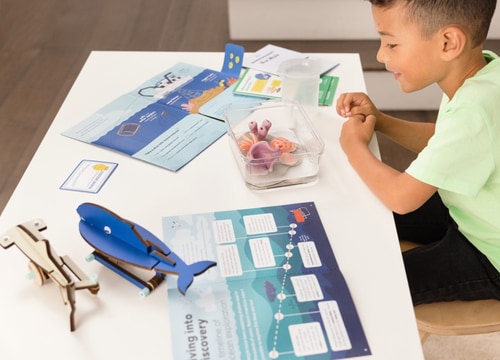
At KiwiCo, we know that kids learn best when their hands, eyes, and minds work together in harmony. When young learners touch textured materials, build physical projects, follow step-by-step visual guides, and explore colorful storybooks, they actively construct essential brain pathways. These pathways support decoding written words, understanding complex narratives, and confidently sharing original ideas with the world.
Hands-on discovery fuels early reading skills and transforms daily storytime into an active, multi-sensory adventure for every age group.
Literacy Begins with Early Curiosity
Long before children start sounding out individual letters, they build foundational pre-literacy skills through active observation, listening, and sensory play. Reading readiness starts with pure curiosity about how physical objects, pictures, and written symbols connect to everyday life.
When newborns and babies explore tactile objects while listening to descriptive language from a caregiver, their brains build strong neural connections between spoken words and real-world objects. This multi-sensory input turns abstract speech into real understanding right from the very start.
A great example of early tactile discovery for newborns and babies is the Atom Bead Maze. Thoughtfully designed for the youngest innovators, this solid beechwood maze lets tiny hands slide colorful, chunky beads around smooth wire tracks modeled after a carbon atom. While babies grip, spin, and slide the beads, parents can read along with the included board book, Hello, Atom!. Hearing natural speech cadences and gentle rhythm while manipulating sturdy wooden pieces creates a wonderful multi-sensory connection during baby's earliest months.
When a baby turns a thick page, points to a bright character, and holds a matching bead, they learn that books hold concepts worth exploring. That simple discovery forms the foundation of lifelong reading motivation.
Story-Driven Hands-On Discovery
Kids love stories because narratives provide context, excitement, and emotional connection. When literacy pairs directly with an engaging storyline or a real-world career, reading transforms into an inspiring invitation to explore.
By connecting storybooks directly with hands-on builds, children experience narrative structure in an interactive way. They read about a character facing a problem in a book, then construct a tangible project that solves that exact problem in real life. This active participation deepens comprehension, strengthens memory, and makes sequence clear.
An exciting example for kids ages 5+ is the Marine Biologist + Who Makes That? Book Bundle. This bundle pairs hands-on ocean science activities with an engaging book that introduces readers to STEM careers and marine life. As children read about ocean creatures and oceanographers, they engage with physical projects that mirror the story. Connecting narrative concepts directly to tangible play helps kids practice key comprehension skills like identifying main ideas, making logical predictions, and understanding cause and effect.
Vocabulary in Action
A rich, varied vocabulary strongly predicts long-term reading comprehension. Children who regularly hear and use descriptive words build a robust cognitive foundation for understanding complex texts as they grow.
Memorizing word definitions off a list rarely excites young learners. Kids retain vocabulary best when they experience words in active context. When a child learns words like excavate, fossil, molecule, orbit, or ecosystem while physically handling related objects, those words make a lasting impression.
Hands-on projects naturalistically expand a child's working vocabulary across multiple domains:
Scientific Terms: Concepts like nucleus, electron, and molecule become accessible to parents and babies during play with the Atom Bead Maze (for newborns and babies).
Field Science Terminology: Words like geologic timescale, impression, and strata come alive while using the tools in the Paleontologist Starter Kit (for ages 5+).
Oceanography Vocabulary: Terms like habitat, conservation, and marine ecosystem leap off the page with the Marine Biologist + Who Makes That? Book Bundle (for ages 5+).
Encountering these rich words during interactive play gives kids the confidence to use them in daily conversations and recognize them effortlessly in future reading.
Print Awareness and Engagement
Print awareness means understanding that written marks on a page represent spoken words, creative ideas, and functional instructions. Seeing print in action shows kids that reading is an empowering tool.
KiwiCo instruction booklets and activity guides foster print awareness in growing readers. Filled with colorful illustrations, clear step-by-step diagrams, numbered sequences, and concise labels, our guides show kids how written instructions turn directly into physical projects.
In the Paleontologist Starter Kit (ages 5+), kids follow step-by-step booklets, check off bone identification sheets, and explore a colorful dinosaur poster filled with facts. Matching written labels to physical bone models reinforces how text conveys meaningful details. As children follow numbered steps from left to right and top to bottom, they naturally master print directionality, caption reading, diagram interpretation, and key visual structures of informational text.
Confidence Through Context
Building emotional confidence stands out as a big milestone in early reading. When a young child feels unsure around unfamiliar words or abstract ideas, momentum can slow down.
Hands-on context bridges that gap by grounding abstract ideas in physical experience. Building a tangible project alongside reading a book turns complex topics into approachable adventures. Reading about ocean currents or dinosaur fossils feels welcoming when a child has already felt, built, or observed the topic in action.
This boost in confidence encourages kids to take creative risks in reading. They jump eagerly into new books, tackle unfamiliar words independently, and share what they learn with parents, teachers, and friends.
Practical Ways to Support Reading Readiness at Home
Supporting reading readiness doesn't require rigid schedules or formal drills. Simple, intentional daily habits create an environment where literacy flourishes naturally through play and conversation.
1. Read Aloud Every Single Day
Reading aloud exposes children to rich language structures, diverse storytelling formats, and fun new words. Make storytime interactive by pointing to illustrations, asking open-ended questions about what happens next, and inviting your child to turn the pages.
2. Pair Stories with Hands-On Play
When you finish reading a storybook, extend the fun into the real world. If you read a book about ocean life, build a pretend coral reef out of blocks or clay. If you read about space, craft simple cardboard rockets together. Connecting stories to creative projects helps kids process narrative structure and sequence events easily.
3. Talk Through Everyday Activities
Narrate daily activities using rich, descriptive language. Whether you are baking treats, organizing a bookshelf, or planting seeds in the garden, introduce specific terms like ingredients, measure, alphabetical, or germination. Hearing descriptive vocabulary in everyday contexts builds a strong mental dictionary.
4. Create a Literacy-Rich Environment
Keep books, drawing supplies, paper, and hands-on activity kits easily accessible to your child. Display books with covers facing outward so children feel drawn to colorful artwork. When tools for reading and building stay within arm's reach, self-directed discovery happens naturally every day.
5. Encourage Spatial and Fine Motor Play
Building with wooden blocks, solving puzzles, squeezing playdough, and using child-safe scissors all strengthen hand dexterity and spatial processing. Strong fine motor control directly supports comfortable pencil grip, fluid writing, and tracking words across printed lines.
Empowering Young Readers
Reading readiness blossoms best through joy, active curiosity, and open-ended play. By surrounding children with inspiring storybooks, visual guides, rich vocabulary, and hands-on projects, we help them discover that books are incredible gateways to real-world adventures.
Whether your baby is exploring tactile sensory play with the Atom Bead Maze (for newborns and babies), or your young adventurer is unearthing prehistoric fossils with the Paleontologist Starter Kit or diving into marine life with the Marine Biologist + Who Makes That? Book Bundle, every KiwiCo experience helps turn eager listeners into confident, lifelong readers.