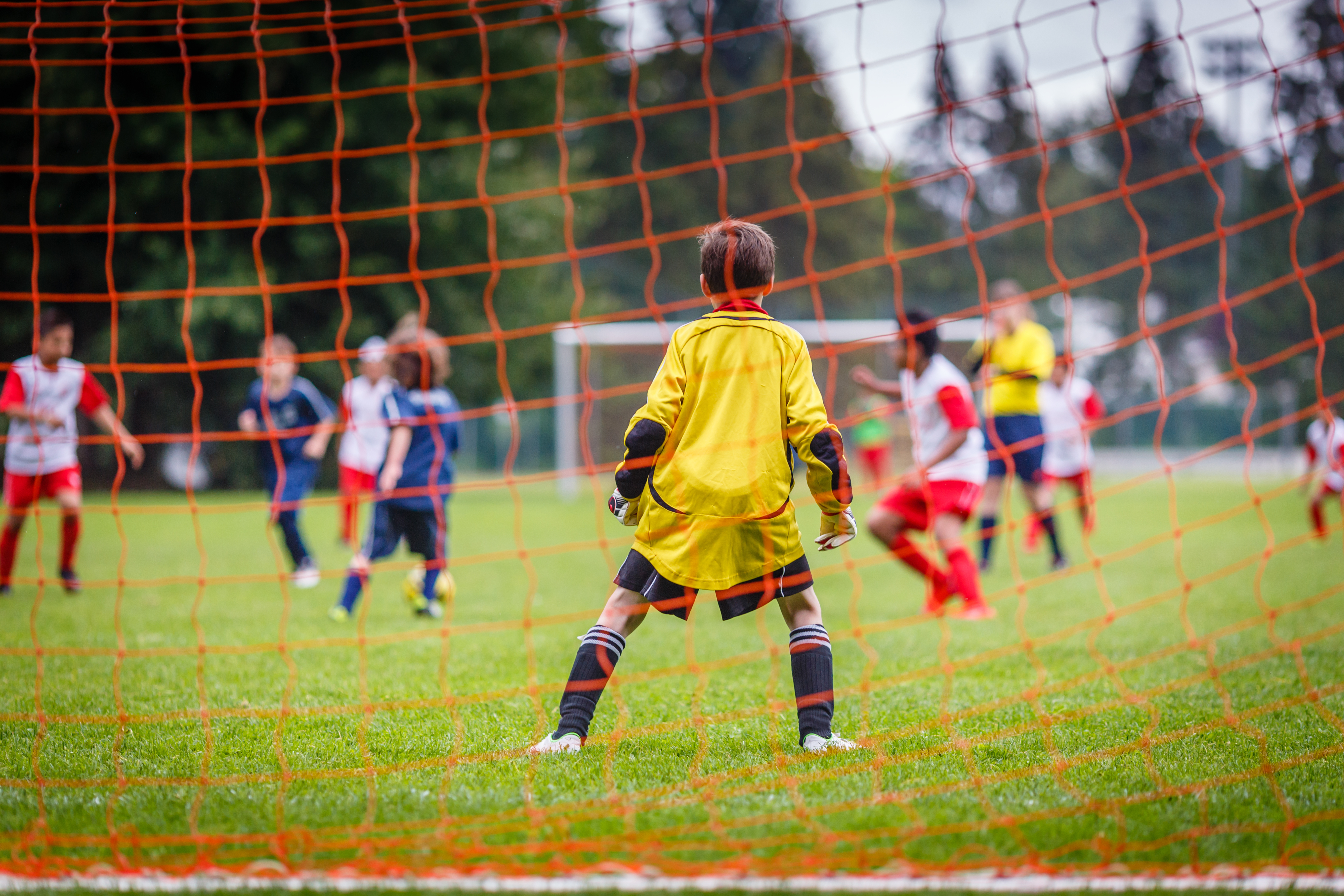
Watch a penalty kick in slow motion and something strange happens. The goalkeeper is already moving before the ball leaves the player’s foot. In other words, the goalkeeper committed before the ball was even struck.
You might chalk it up to reflex, but it’s not that simple. It's a trained brain doing something remarkable. And the science behind it says something interesting about how all kids learn; not just the ones in goal.
What's actually happening in those 0.4 seconds
A penalty kick from the spot reaches a goalkeeper in roughly 0.4 seconds. The average human reaction time sits around 0.2 to 0.5 seconds. So by the time the brain sees the ball, processes where it's going, and fires the right muscles, there's almost no margin left to move a whole body across a goal.
Elite goalkeepers solve this by not waiting for the ball. They read the kicker before the kick even happens. The angle of the hips. The position of the plant foot. The direction of the eyes. Their brains read a flurry of signals from the kicker's body and commit to a direction before the ball moves.
Research comparing expert and novice goalkeepers backs this up consistently. Studies across 20 separate trials show that experienced goalkeepers pick up directional cues earlier and use them more accurately than beginners do. Decision-making time in experienced goalkeepers clocks in at 250–260 milliseconds, compared to 300–320 milliseconds in novices. That gap doesn't come from biology alone.
Some of this is built, not born
Reaction time has a genetic component. Studies on twins suggest genetics plays a real role in how fast someone's baseline reaction speed is. So some kids do start with a natural edge.
But that leaves a lot of room. The rest is shaped by experience, and the mechanism is well understood. Every time the brain repeats a movement or a decision, it prunes the slower neural pathways and reinforces the faster ones. Neuroscientists call this neuroplasticity. The brain physically rewires itself in response to practice.
This is why an experienced goalkeeper doesn't react faster in a purely biological sense. Their brain has logged thousands of penalty situations. It's built a library of patterns. When a familiar cue appears, it's matching, not solving from scratch.
Your kid's brain is doing a version of this right now, in whatever they practice most.
It's not just sport
The same loop shows up well outside of sport. Any activity that asks kids to read a fast-changing situation, make a decision, and adjust based on what happens next is exercising the same cognitive circuit.
Building a project that doesn't work the first time. Playing a game where the rules become clear only after a few rounds. Tinkering with something to figure out why it's not doing what they expected. None of these look like goalkeeper training. But they're all running the same brain process: observe, predict, act, revise.
Some research shows reaction speed improves with practice in children, and the brain is particularly responsive to this kind of training during childhood. And it's not just raw speed that gets better; it's how accurately they predict what's coming next.
What this means for the kids watching the World Cup
The next time your kid watches a goalkeeper make an impossible save, they're seeing thousands of hours of pattern-building pay off in half a second.
And the next time your kid gets frustrated that something isn't working on the first try, that's worth naming. The attempt is the training, and the adjustment is what the brain is there for.
If your kid is the kind of person who wants to understand how things work and then push at them, Kiwi Crate and Tinker Crate are built around exactly that loop. Each month brings a project that requires adjusting and figuring it out. It’s a similar cycle that turns a novice goalkeeper into someone who moves before the ball does.
What did your kid notice while watching the World Cup? Tell us in the comments.