At KiwiCo, we believe early math education should feel like an exciting playground adventure. When mathematical concepts begin with hands-on physical experiences, children construct an intuitive mental framework that supports them throughout their entire academic journey. Touching physical objects bridges the gap between abstract symbols and real-world meaning. Through deliberate, sensory-rich play, abstract concepts such as numerical value, geometry, pattern logic, and measurement turn into meaningful tools that children use to solve problems, make decisions, and express creative ideas.
In this comprehensive guide, we will explore the core benefits of tactile mathematical learning, break down the pillars of early math development, and highlight how targeted projects make math learning intuitive, joy-filled, and stress-free for the whole family.
Number Sense, Counting, and Subitizing
Developing strong number sense represents the absolute bedrock of mathematical achievement. True number sense goes far beyond reciting "1, 2, 3, 4, 5" from memory. Rote verbal counting is primarily a memory exercise, similar to reciting the letters of the alphabet. Real mathematical fluency starts when a child understands one-to-one correspondence, which is the knowledge that each spoken number word matches exactly one physical object in a set. Understanding that the spoken word "three" corresponds directly to three wooden blocks, three berries, or three distinct hand claps transforms a memorized word into a concrete quantity.
Another vital element of early number sense is subitizing. Subitizing is the cognitive ability to instantly recognize the quantity of a small group of items without counting them one by one. For instance, when you roll a standard die and instantly recognize a group of four dots without pointing your finger at each dot, you are subitizing. Developing this visual skill helps children perceive numbers as flexible groups rather than isolated single units, paving the way for effortless mental addition and subtraction later on.
Physical toys make these internal numerical relationships completely visible and touchable. For example, the Rainbow Block Numbers set turns abstract numeric symbols into chunky, tactile blocks that children can hold, stack, and balance. Each translucent number block corresponds directly in height and scale to its numeric value. When a child stacks a 2-block and a 3-block side-by-side with a 5-block, they physically see and feel that two and three combine to equal five. Placing these vibrant numbers into a fitted puzzle frame strengthens visual problem-solving while solidifying numeral recognition and spatial estimation.
Sensory play offers another powerful avenue for reinforcing quantity awareness. With the Sensory Sand Shaved Ice Maker, children run a pretend shaved ice counter while practicing foundational counting. Kids push physical sliders on a built-in counting board to fulfill incoming customer orders, molding exact numbers of sand ice cubes and berry toppings. Moving a slider while counting out three red sand scoops builds a deep sensory connection between physical motion, visual numbers, and exact physical amounts.
Tips for Building Number Sense
Practice Subitizing at Snack Time: Place two or three small items (such as crackers or grapes) on a plate. Ask your child to tell you how many items are there without counting them one by one. Gradually increase the number as their visual recognition grows.
Touch-and-Count Daily Routines: Whenever your child helps around the house, encourage them to touch each item as they count aloud. Count stairs while walking, shoes at the front door, or buttons on a sweater to reinforce one-to-one correspondence.
Spatial Reasoning
Spatial reasoning is the mental ability to visualize objects, understand their unique geometric properties, and evaluate how shapes manipulate and fit together in physical space. Long-term educational research demonstrates that strong spatial skills developed in early childhood strongly predict future performance in science, technology, engineering, and advanced mathematics. Spatial awareness helps children master geometry, read maps, visualize complex mechanical systems, and execute multi-step problem-solving.
Children begin exploring geometric principles long before learning formal vocabulary like perimeter, vertex, or symmetry. They discover geometry naturally when balancing a triangular block on top of a square to construct a roof, realizing that two equal right-angled triangles combine to form a square, or rotating a puzzle piece until it aligns perfectly with a cutout opening.
Interactive crates create ideal testing grounds for spatial relationships and shape transformations. The Sensory Play Lightbox elevates shape recognition into an illuminated, interactive experience. As children arrange translucent geometric tiles across the glowing lightbox, they discover symmetry, shape combination, and spatial orientation. Placing two right triangles together on the lightbox reveals a crisp square, while layering different translucent shapes shows how geometric forms combine to create new shapes and colors. Raised outer edges on the tiles allow small hands to rotate and reposition pieces easily, building fine motor precision right alongside geometric intuition.
Tactile craft materials also make flat geometry feel alive and dynamic. Through the Fun Dough Pasta Maker, young chefs roll out colorful playdough and use child-friendly tools to craft circular, triangular, and square ravioli. Following included shape pattern cards guides children to recognize defining geometric attributes (such as counting three distinct corners on a triangle or four equal sides on a square) while rolling, pressing, and cutting dough. Shaping flexible playdough into clean geometric structures connects abstract math terminology directly to hand movement.
Tips for Spatial Reasoning
Use Rich Spatial Vocabulary: Incorporate spatial positional words into everyday conversations. Instead of saying "put that over there," use explicit directional language such as "place the square box under the table," "rotate the book clockwise," or "set the bowl adjacent to the plate."
Go on a Shape Hunt: Challenge your child to spot geometric shapes in everyday environments. Look for circular clock faces, rectangular doors, triangular street signs, or hexagonal floor tiles during neighborhood walks.
Patterns and Logic
Mathematics is often described as the study of patterns and logical relationships. Patterning involves noticing, extending, and creating repeating sequences of colors, shapes, textures, sounds, or physical actions. Recognizing patterns empowers children to organize complex visual information, predict outcomes, and develop systematic reasoning skills that serve as the foundation for algebra and computational thinking.
Sequencing is closely connected to patterning. It requires understanding logical order, step-by-step procedures, and cause-and-effect connections. Whether following a recipe, building a structure according to instructions, or telling a chronological story, sequencing helps children break down multi-step tasks into clear, ordered phases.
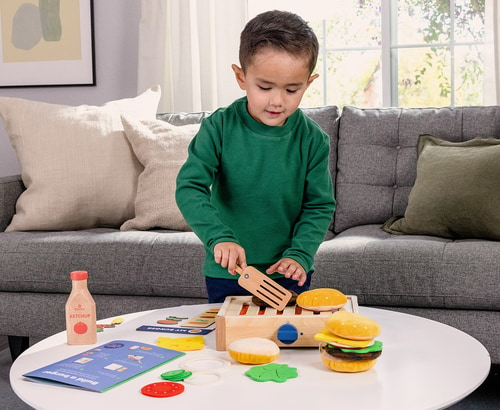
Imaginative cooking activities present an engaging avenue for practicing logical sequencing. The Build-a-Burger Grill crate invites children to act as master pretend chefs using recipe activity cards. Kids construct delicious-looking skewers by picking ingredients in exact sequences, such as creating a repeating AB pattern using peppers and mushrooms, or an ABC pattern featuring tomatoes, onions, and zucchini. Arranging them on a burger, placing those burgers on a toy grill, and flipping them in specific order teaches children how individual steps merge into a structured, successful process.
Sorting is another foundational sorting skill that enhances pattern awareness. Sorting objects by size, color, shape, weight, or material teaches children to analyze specific attributes, categorize data, and classify information efficiently.
Early Math Pillar | Core Skill Focus | Practical Classroom & Home Application |
|---|---|---|
Number Sense | One-to-one correspondence, subitizing, quantity comparison | Counting physical objects, sliding counters, visual grouping |
Spatial Reasoning | Geometry, 2D to 3D translation, symmetry, rotation | Shape puzzles, tile layering, light box construction |
Patterning & Logic | AB/ABC patterns, sequencing steps, attribute sorting | Skewer recipe building, dough stamping, color classification |
Everyday Measurement | Pretend currency, value exchange, volume estimation | Market transactions, sorting produce, weighing ingredients |
Tips for Patterns and Sorting
Create Household Patterns: During cleanup time or play, set up simple repeating patterns using household items. Lay down a pattern using socks, colored blocks, or spoons (such as fork, spoon, fork, spoon) and ask your child to place the next item in the sequence.
Attribute Sorting Games: Empty a container of mixed buttons, coins, or plastic building bricks. Ask your child to sort them into distinct piles based on one specific characteristic, such as color, size, or number of holes.
Practical Math
When mathematical learning connects directly to everyday scenarios, children instantly recognize its value and real-world relevance. Practical everyday math encompasses volume estimation, weight comparison, managing pretend currency, and conducting simple store transactions. Pretend play naturally incorporates these mathematical activities, providing children with a comfortable, low-stakes environment to experiment with value exchange, counting money, and practical problem-solving.
Market-themed play brings multiple mathematical pillars together into one captivating scenario. Farmers Market allows children to construct felt produce, label mini chalkboard signs with prices, set up display baskets, and run a bustling neighborhood market. As children "sell" homemade felt tomatoes, carrots, and beaded pea pods to family members, they practice counting play coins, giving change, sorting items into produce baskets, and estimating quantities. Figuring out how many coins a customer must pay for three carrots transforms basic addition and subtraction into a rewarding social game.
Interactive measurement play also introduces early concepts of weight, capacity, and balance without needing complex formulas. When children scoop sand, compare heavy and light felt vegetables, or divide playdough into equal portions, they establish a concrete grasp of how quantities behave in the physical world.
Tips for Practical Math
Include Kids in Kitchen Math: Involve your child in daily meal preparation. Let them assist in measuring ingredients using cups and spoons, counting the required number of dinner plates, or dividing snacks into equal portions for siblings.
Real-World Shopping Math: During trips to the grocery store, ask your child to help choose produce based on count or weight. Ask them to pick out four apples or help place heavy items on the produce scale to observe the indicator movement.
Why KiwiCo Design Works
Learning mathematics should always feel empowering, creative, and joyful. At KiwiCo, every crate is engineered by dedicated educators, engineers, child development experts, and real kids to guarantee that foundational math concepts emerge naturally through play. Here are the core design principles guiding our products:
Self-Correcting Mechanics: Our project tools are built so children can test hypotheses independently. If a puzzle piece does not fit or a block balance fails, the physical feedback allows children to adjust their strategy without feeling discouraged or relying on adult intervention.
Multi-Sensory Materials: By pairing vibrant visual colors with tactile textures (such as moldable sand, smooth wood, flexible felt, and squishy dough), our crates engage multiple sensory pathways simultaneously, strengthening memory retention and topic comprehension.
Open-Ended Play: Every crate arrives with an illustrated Grownup Guide that outlines structured activities for beginners alongside open-ended extension ideas for older learners. As a child grows, the toy adapts to provide fresh learning challenges.
Storytelling: Placing math challenges inside imaginative storylines (such as running a ice cream shop, baking pretend meals, or managing a market) converts math from a abstract drill into a fun, goal-driven adventure.
Building Math Confidence
Early math development is not about rushing children to complete written equations or memorize arithmetic tables before kindergarten. It is about nurturing curiosity, spatial intuition, flexible thinking, and a creative passion for solving problems. When children explore math concepts through tactile, play-filled activities, they develop genuine confidence that prepares them for future academic success.
By encouraging children to touch, build, arrange, measure, and pretend, we show them that mathematics is a useful, creative tool for exploring how the world works. Whether your child is layering translucent blocks on a lightbox, crafting dough ravioli, or taking customer orders at a market, every hands-on play session builds the foundation for a lifetime of confident learning.