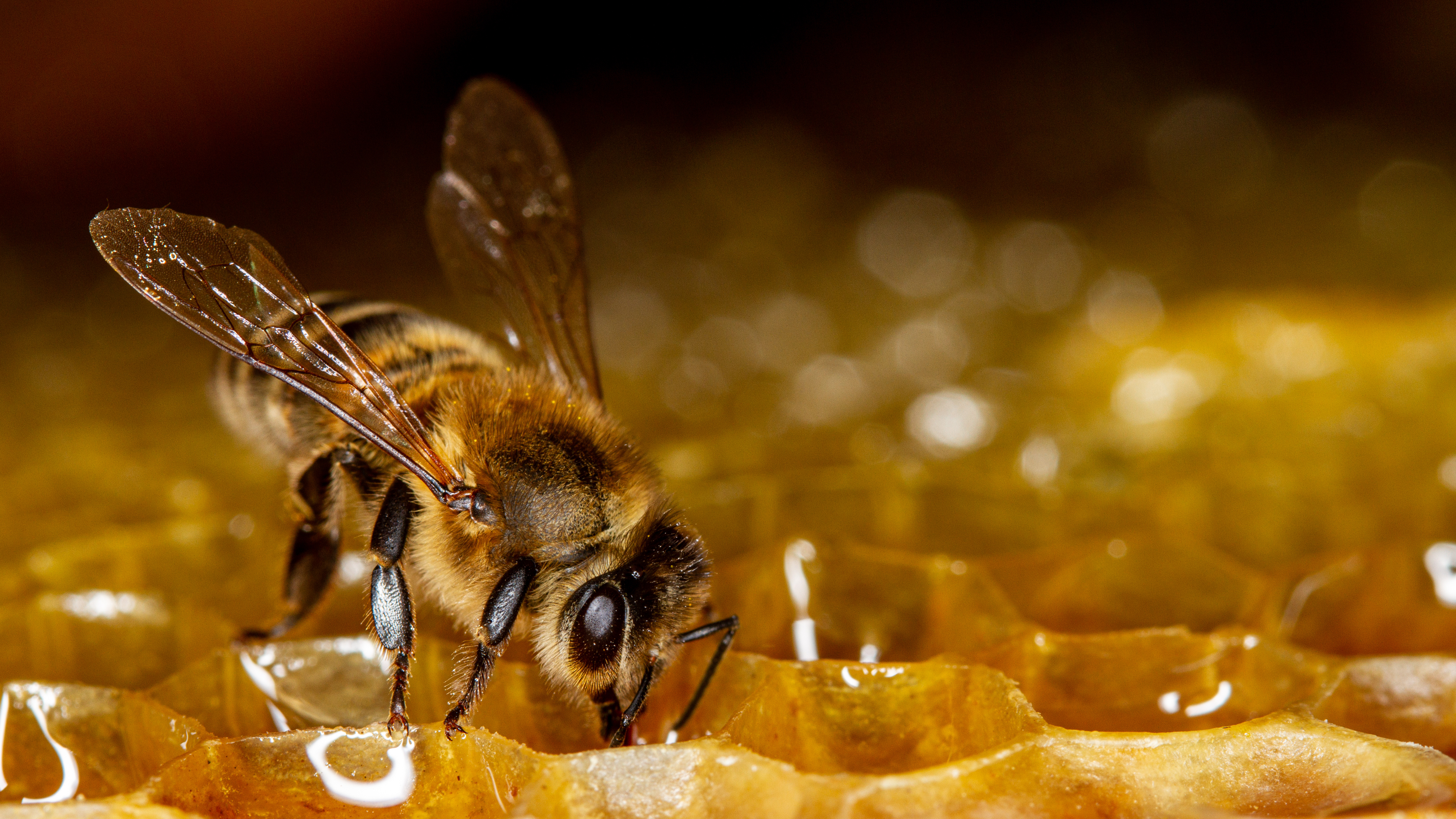
Try picturing a bee. Odds are you pictured something small and stripey, living in a hive with a queen and making honey. That’s a honey bee, and it’s just one kind of bee among more than 20,000 known species. Most bees don’t fit that picture at all. Here are five facts that might change how you look at the next bee bumbling through your backyard.
Bees dance to give directions
When a honey bee finds a good patch of flowers, she flies home and tells everyone where it is by dancing. It’s called the waggle dance. She walks in a straight line while wiggling her body, loops back around, and does it again, tracing a little figure eight. The direction she waggles points the way to the flowers, using the sun as a reference. The longer the waggle lasts, the farther away the food. An Austrian scientist named Karl von Frisch cracked the code of what the dance meant, and he won a Nobel Prize for the work. Watch our video on bees dancing to learn more.
Most bees live alone
Here’s where the honey-and-hive picture falls apart. Of the more than 20,000 known bee species in the world, only a small fraction are honey bees or bumble bees; most are solitary. That means no hive, no queen, and no honey. A single female builds her own little nest, often in a hollow stem or a tunnel in the ground, stocks it with pollen, lays her eggs, and handles the whole job by herself. Many mason bees, leafcutter bees, and mining bees live this independent way, although some build their nests close together. The busy honey bee colony you know best is far from the usual bee lifestyle.
Bees see colors we can’t
Flowers can look very different to a bee than they do to us. Bees have photoreceptors tuned to ultraviolet, blue, and green light. That lets them see ultraviolet light, which is invisible to human eyes, and it means they don’t see red the way we do.
Many flowers have ultraviolet patterns on their petals. These patterns can form rings, centers, or other guides that help bees locate pollen and nectar. Pure red flowers that do not reflect ultraviolet light may be difficult for bees to spot, while blues, violets, and yellows often stand out clearly to them.
Some bees buzz pollen loose
Certain flowers keep their pollen locked up tight, and only a good shake sets it free. Some bees, like bumble bees, have a trick for this called buzz pollination. It works like this: a bee grabs the flower and vibrates its flight muscles, shaking the pollen loose. Tomatoes, blueberries, eggplants, and several other crops are buzz-pollinated. Honey bees can’t perform this behavior, but bumble bees and many other bee species can.
Honey bees can learn to recognize faces
A honey bee’s tiny brain can handle some surprisingly complicated pictures. In one experiment, researchers trained honey bees to fly toward a photograph of one human face to receive a sugary reward. The bees learned to pick that face out from other faces, even during tests when no reward was provided.
Later research found that honey bees pay attention not only to separate features, but also to how those features are arranged. That doesn’t necessarily mean a bee recognizes people the way you recognize your friends. To a bee, a face may simply be one very complicated pattern, but it’s still an impressive feat for such a small brain.
The next time a bee cruises past, remember it’s one of more than 20,000 kinds. It might be a dancer, a loner building a nest in the dirt, or a buzzing pollen-shaker; the classic stripey honey bee is just one face in a huge crowd.
Which fact surprised you most? Tell us in the comments, and let us know what kinds of bees you’ve spotted where you live.