A very brief history
Ancient Egyptians are widely credited as the first to bake leavened bread, around 3000 BCE. They didn't fully understand what yeast was — that would come thousands of years later — but they figured out that leaving dough to sit before baking made it rise and taste better. They were accidentally cultivating wild yeast from the air around them.
The packet of active dry yeast in your pantry is the same species humans have been using for thousands of years, Saccharomyces cerevisiae, just bred for consistency and packaged for your pantry shelf.
What yeast actually is
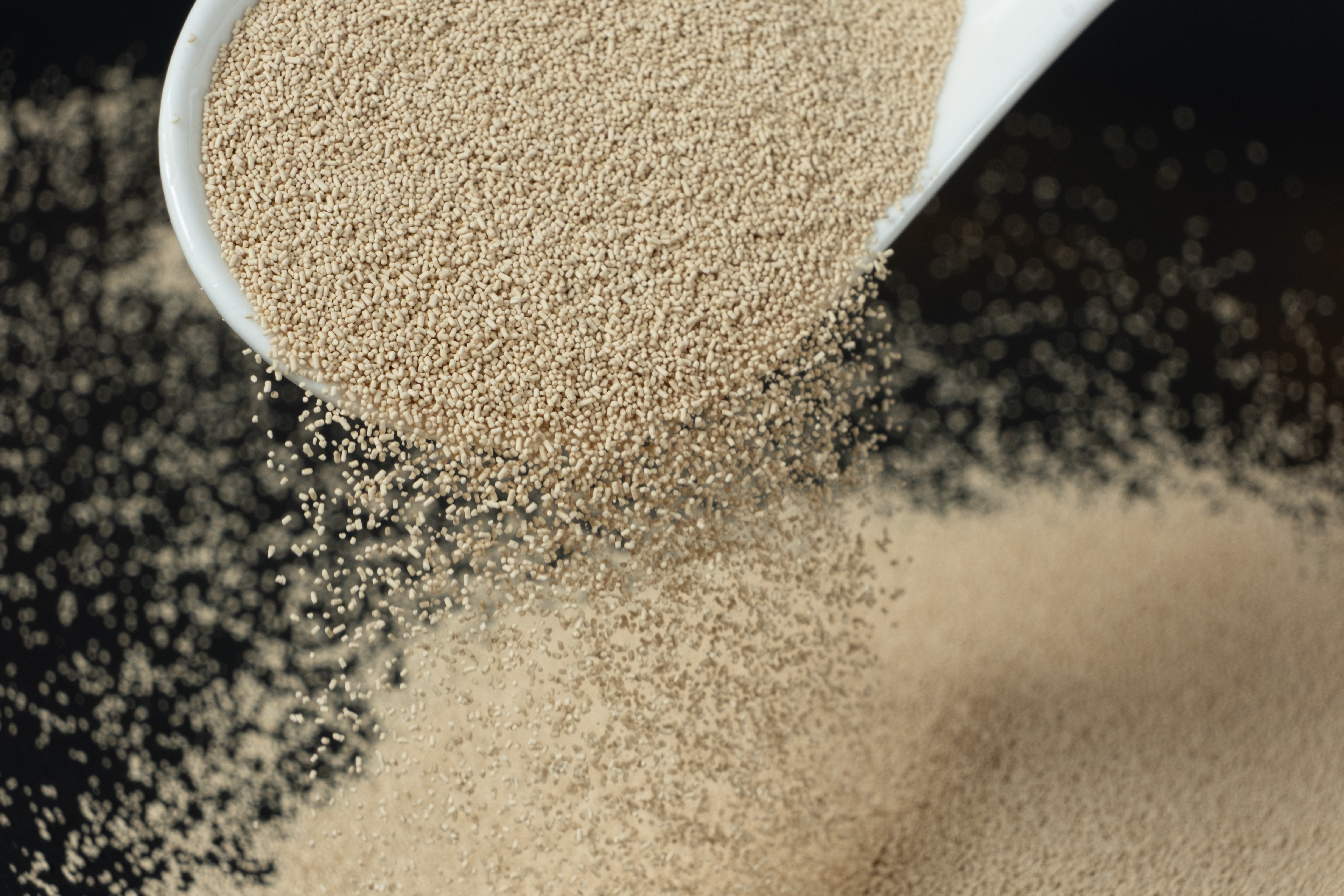
Yeast is a single-celled fungus. Not a chemical or a powder in the abstract sense. Under a microscope, yeast cells are oval-shaped and remarkably simple, but they're capable of something genuinely impressive: fermentation.
When yeast encounters sugar and warmth, it starts to feed. As it metabolizes the sugar, it releases carbon dioxide gas and a small amount of alcohol. Those carbon dioxide bubbles get trapped in the stretchy gluten network of the dough, and as the bubbles multiply, the dough rises. That rise has a name: oven spring. It's the rapid expansion that happens in the first minutes of baking, as a final burst of yeast activity, expanding gas bubbles, and heat all work together before the dough sets.
Why conditions matter so much
Yeast is alive, which means it has preferences. It works best in a warm environment, roughly 75–95°F. Too cold and it goes dormant, and the dough barely moves. Above around 120°F, it starts to die, and the dough never rises at all.
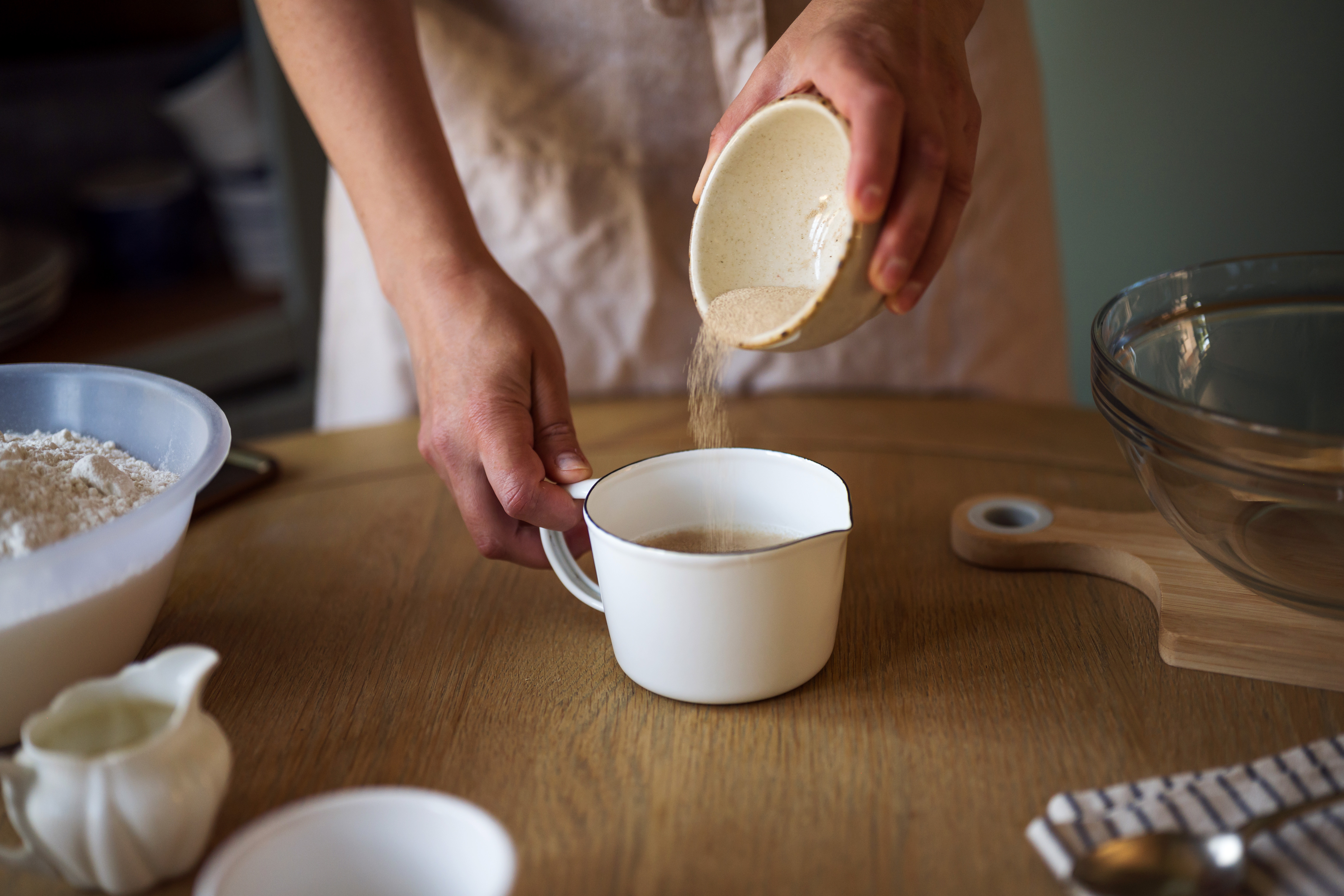
This is one of the most tangible experiments you can run in the kitchen. Proof yeast in water that's too cold, water that's too hot, and water at the right temperature. Watch what happens. One bowl bubbles and foams. The other two do nothing. The difference is entirely about whether the organism is alive and active. You can see it in about ten minutes.
The 5,000-year-old question
Humans have been asking why bread rises since before we had the science to answer it. The proof that fermentation was a biological process, driven by living microorganisms and not spontaneous chemistry, didn't come until Louis Pasteur's work in the late 1850s. For most of human history, bakers just knew that it worked, not why.
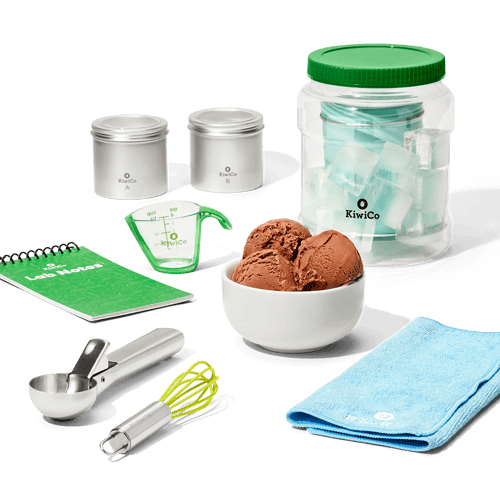
Sharing that history adds something to the act of baking. The loaf rising on the counter connects your kitchen to ancient Egypt, to medieval bakeries, to every culture that has ever made bread. That's a long line to be part of. For families who want to explore that science hands-on, KiwiCo's Science of Cooking: Bread & Butter covers yeast, gluten, and emulsion through real recipes and built-in experiments, with every tool you need included.
What would your family bake if you had 5,000 years of bread-making knowledge behind you? Share in the comments.