Summer is long, and unstructured time is a gift until about day four, when someone needs a plan. Well, this is the plan.
The 30-Day ‘Going Analog’ Summer Challenge gives kids one hands-on project every day for a month: building, experimenting, cooking with science, and exploring outside. No screens required. No special trips to the store. Just a daily project that takes anywhere from 15 minutes to an afternoon, organized into four themed weeks so there's always a clear starting point.
The four weeks build on each other loosely. Week one is for building and engineering. Week two moves outside into nature and science. Week three brings things into the kitchen for food science and chemistry. Week four is the biggest challenges of the summer, projects that take more time and produce something worth keeping.
Helpful tip: print out the ideas and pin them to the fridge, then cross off each day as you go.
How to Use This Challenge
Each day has one project with a direct link to the full instructions on KiwiCo's DIY page. Most projects use materials you already have at home; a few need a quick supply check the night before. Those are marked with a ★ so you can plan ahead.
The challenge works for ages 6–14 because the projects span a wide range of complexity. Younger kids will need a grown-up alongside for some of the Week 4 projects. Older kids can run most of Week 1 and 2 independently once you've shown them where the supplies are.
One project a day is the goal. If you miss a day, pick up where you left off. The challenge doesn't reset; it just continues.
Week 1: Build It
This week is all about engineering. Kids build things that move, fly, protect, and launch. Every project has a clear goal and room to fail, which is the best kind of setup. By day seven, most kids have figured out that the second attempt is always better than the first.
Day 1: Egg Drop Challenge Build a device that protects a raw egg from breaking when dropped from a height. Use whatever materials you can find: cardboard, rubber bands, cotton balls, tape. Drop from a deck railing or second-story window. See what survives. (45 min)
Day 2: Balloon-Powered Rocket Build a rocket, attach it to a string via balloon, and test how far it travels. Change the balloon size, the cargo weight. The experiment resets in two minutes, which means kids naturally run it a dozen times. (15 min)
Day 3:★ Electromagnetic Train A AA battery, a coil of copper wire, and two disc magnets. Build a miniature train that propels itself down the track using electromagnetism. The moment it starts moving is genuinely surprising every time. (20 min; needs copper wire and disc magnets)
Day 4: Cardboard Chair Challenge Using only corrugated cardboard, build a chair or stool that can hold a person's weight. Triangles are the strongest shape. The corrugate is strongest when vertical. Everything else is up to the builder. (45 min–1 hr)
Day 5: ★ Baking Soda Bottle Boat Build a small boat powered by a baking soda and vinegar chemical reaction. Race it across a tub or kiddie pool. The propulsion is the same reaction as a classic volcano, just pointed in a direction this time. (30 min; needs baking soda, vinegar, plastic bottle)
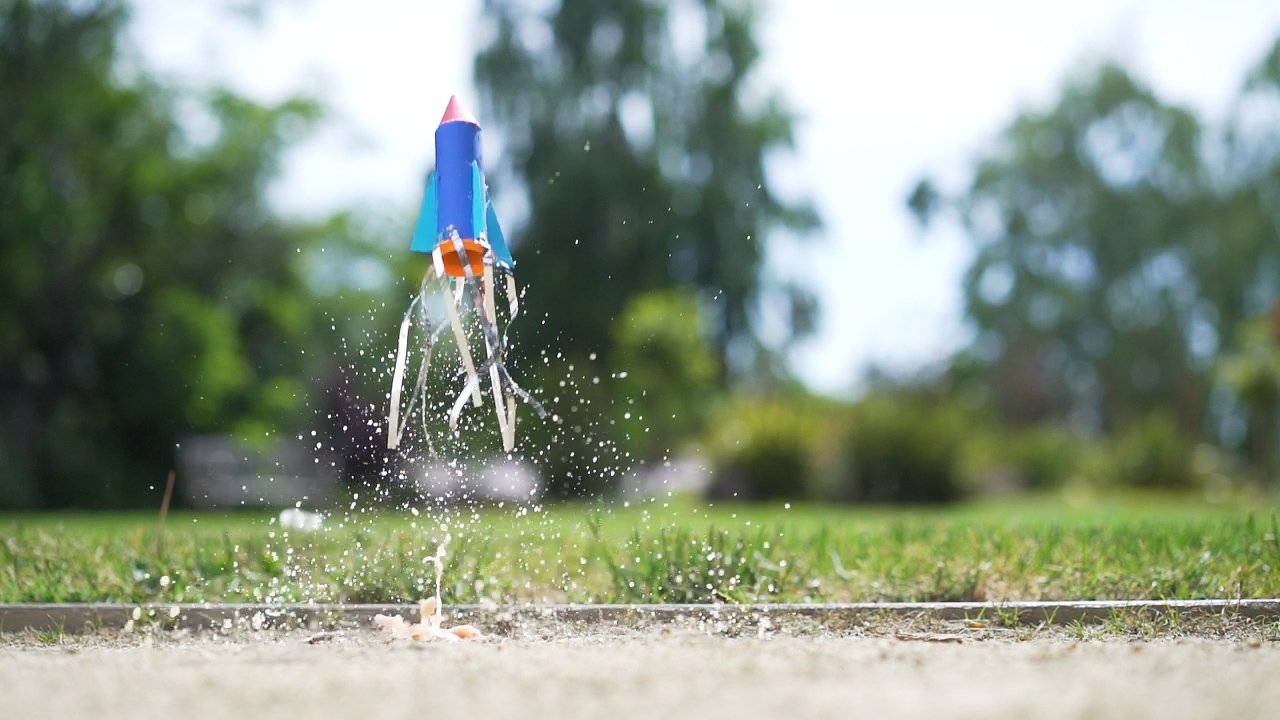
Day 6: Water Pressure Rocket Build a water-pressure-powered rocket and launch it in the backyard. This one goes surprisingly high. Do it away from anything breakable. (30 min)
Day 7: Egg in a Bottle Use expanding and contracting gases to pull a hard-boiled egg into a glass bottle whose opening is too small for it to fit through normally. Fast to set up, immediately surprising, and leads naturally into questions about air pressure. Then figure out how to get the egg back out. (20 min)
Week 2: Grow and Explore It
This week takes things outside. The projects use sunlight, water, plants, and living things as the materials. Some results are immediate. Some take a few days to develop, which means kids keep checking back. Both are good outcomes.
Day 8: ★ Solar Oven S'mores Build an oven from a cardboard box, aluminum foil, plastic wrap, and black construction paper. Point it at the sun. Come back in 30 minutes to melted s'mores. The physics (reflectivity, heat trapping, solar energy) comes up naturally when kids start asking why it works. (20 min build + 30 min cook time; needs full sun)
Day 9: ★ Eggshell Geodes Grow borax crystals overnight inside emptied eggshells. The finished geodes look like genuine mineral specimens. Experiment with different borax concentrations to see how crystal size changes. Results appear by morning. (20 min + overnight; needs borax)
Day 10: Giant Bubble Wand Build a giant bubble wand from household materials and test different soap solutions. The science of why bubbles form a sphere (surface tension minimizing surface area) is real physics that comes out naturally. See who can make the biggest bubble before it pops. (20 min)
Day 11: Tin Can Lantern Hammer nail patterns into a tin can filled with frozen water (the ice keeps the can from denting), fit it with a battery-powered tea light, and watch the patterns appear on the walls at night. Plan your design before you start hammering. (45 min + freezing time the night before)
Day 12: Plant Light Maze — kids build a cardboard maze and watch a plant navigate toward the light over several days. Slow-burn payoff that keeps kids checking back daily. Needs a few days to develop so good to set up on Day 12 and observe through the week.
Day 13: Flying Tea Bag Experiment — burn a tea bag so it becomes a hollow cylinder of ash, stand it upright, and light the top. Hot air rising inside the tube lifts the ash off the table and carries it up into the air. It's a hot air balloon in miniature. Outdoor, fast, dramatic, and teaches thermal air currents. Ages 9–16, grownup needed. (30 min)
Day 14: Campfire Chemistry Place a marshmallow directly into hot campfire coals and watch it grow to three times its original size. The science behind it is genuinely interesting: burning sugar produces water vapor, and when the burning reaches the inside of the marshmallow, the vapor can't escape. It puffs the marshmallow up from the inside like a tiny hot air balloon. Compare it to a fresh marshmallow, then eat the evidence. Grownup supervision required. (Under 30 min; needs a campfire or fire pit)
Week 3: Cook and Create It
This week is kitchen science and art. Projects use food, paint, light, and color to teach chemistry and physics in a format that ends with something to eat, display, or show off. Most of these work at the kitchen table or just outside the back door.
Day 15: ★ Gummy Bear Experiment Put gummy bears in different liquids (water, salt water, sugar water) and observe what happens over 24 hours. Measure before and after. The osmosis at work here is real chemistry, and because kids can predict outcomes and test them, it runs like a proper experiment. (20 min setup + 24 hr wait)
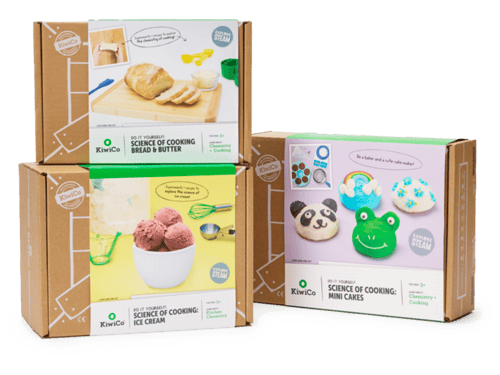
Day 16: ★ Homemade Gummies Make real fruit gummies from scratch using gelatin and juice. The chewy texture comes from polymers, and kids can vary the gelatin ratio to see how firmness changes. The experiment ends with something edible, which is the best kind of result. (30 min; needs gelatin)
Day 17: ★ Cabbage pH Lab Use purple cabbage juice as a pH indicator to test whether common household substances are acids or bases. Vinegar turns it red. Baking soda turns it green. The color changes are dramatic and immediate, and kids can test anything in the kitchen they're curious about. (30 min; needs red cabbage)
Day 18: Milk Plastic Tags Make a simple plastic material from milk using the same chemistry as early 20th-century plastics. The resulting material can be molded and shaped while warm. Kids end up with something they made from a glass of milk, which is genuinely surprising. (30 min)
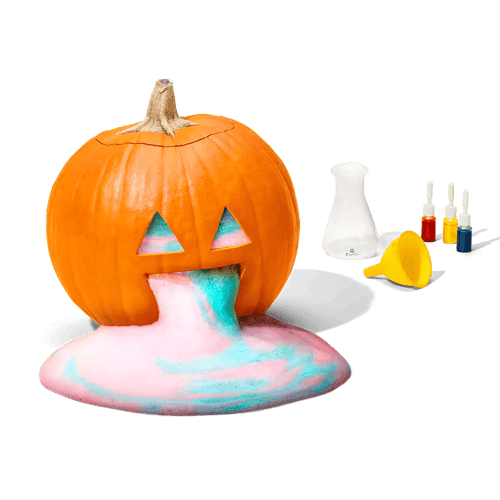
Day 19: Underwater Fireworks Add drops of food coloring in oil to a glass of water and watch them slowly burst into color as the oil and water separate. It takes about two minutes to set up and produces something that looks far more dramatic than the ingredients suggest. (10 min)
Day 20: Glow Gelatin Experiment — make gelatin that glows under a black light using tonic water and fluorescent substances. Two ingredients, dramatic visual result, teaches fluorescence and light science.(2+ hours)
Day 21: Dancing Sprinkles Place sprinkles on a taut surface near a speaker and watch them move and form patterns as sound waves pass through. Test different frequencies, materials, and surfaces. The physics of vibration and sound waves comes up naturally. Hard to stop experimenting with once it starts. (15 min)
Week 4: The Big Builds
This is the hardest week. The projects take longer, require more planning, and produce results that last beyond the afternoon. Some span multiple days. These are the ones kids will remember in September.
Day 22: Egg Drop Challenge: Hard Mode Go back to Day 1's egg drop, but this time raise the stakes significantly. Drop from the highest safe point available. Add a weight limit on the contraption. No parachutes allowed. Ban whatever material worked in round one. The design decisions compound fast. (45 min)
Day 23: Rubber Band Racer — build a working rubber band-powered car using skewers, straws, lollipop sticks, and a drill. Requires adult assistance for the drill step, which makes it appropriately Week 4 in complexity. Kids can race their builds and iterate on wheel design. (45 min)
Day 24: Water Wheel — build a working water wheel outside and test how it converts the energy of falling water into rotational motion. Good outdoor engineering project for an afternoon. (30 min)
Day 25: ★ Graphite Circuit Draw a circuit with a graphite pencil and complete it with an LED. Because graphite conducts electricity, a thick enough line closes the circuit and lights the bulb. Kids can experiment with line length and thickness to see how it affects brightness. (20 min; needs an LED)
Day 26: Pop-Top Rockets Use a chemical reaction to launch mini rockets made from film canisters or pop-top containers. These go fast and need to be done outside, pointed away from people. Kids will want to adjust the water-to-tablet ratio and test which gets the highest launch. (20 min; do outside)
Day 27: ★ Spinning Sculptures Bend copper wire into a sculpture of any shape, balance it on top of a AA battery with a neodymium magnet underneath, and watch it spin on its own. The physics behind it is the Lorentz Force: the collision between an electric current and a magnetic field that produces rotational motion. Getting the sculpture to balance is the hard part, and it takes real trial and error. Once it's spinning, kids almost always want to make another one in a different shape. The result is a working motor that also looks like something worth keeping. (45 min; needs copper wire and neodymium magnets)
Day 28: ★ Muscle Machine Build a mechanical arm from cardboard, brads, and string that works exactly the way a real arm does: one string pulls the arm up (bicep), the other pulls it down (tricep). Get it right and the arm can pick things up. The build requires precise cutting and assembly, and getting the lever connections to move smoothly takes a few attempts. Kids who stick with it end up with something that genuinely mimics human anatomy, which tends to prompt a lot of questions about how the rest of the body works. Download the printable template before you start. (1 hr; needs cardboard, brads, string, zip ties, and a printable)
Day 29: Pasta Bridge Engineering Challenge Build the strongest bridge you can using only dry pasta and a small amount of glue. Span a gap between two chairs or stacks of books, then load test it with increasing weight until it fails. The first design almost always collapses faster than expected, which is the whole point: kids figure out that triangles distribute weight better than flat spans, that thicker sections hold more load, and that where you place the supports matters as much as how much pasta you use. Rebuild with what you learned. The second bridge is always stronger. (1 hr; needs dry pasta, glue, and a way to measure load)
Day 30: Kid's Choice Look back at the 29 projects from this summer. Pick the one your kid most wants to do again, do it harder, or show someone else. This is the day to go back to whatever grabbed them most and push it further. No instructions needed.
Thirty days goes faster than it sounds. By the time your kid builds their first egg-drop device, grows their first crystal, and figures out how to get an egg into a bottle it shouldn't fit in, summer has a shape to it. Something to look forward to each morning. Something to talk about at dinner. That's what ‘going analog’ this summer is all about.
Which week are you most excited about? Drop a comment below and tell us whether your family is more Build It, Explore It, Cook It, or Big Builds. If you try a project and want to share how it went, tag us @kiwico_inc
Save this post for the start of summer and come back to it every Monday for your week's lineup.